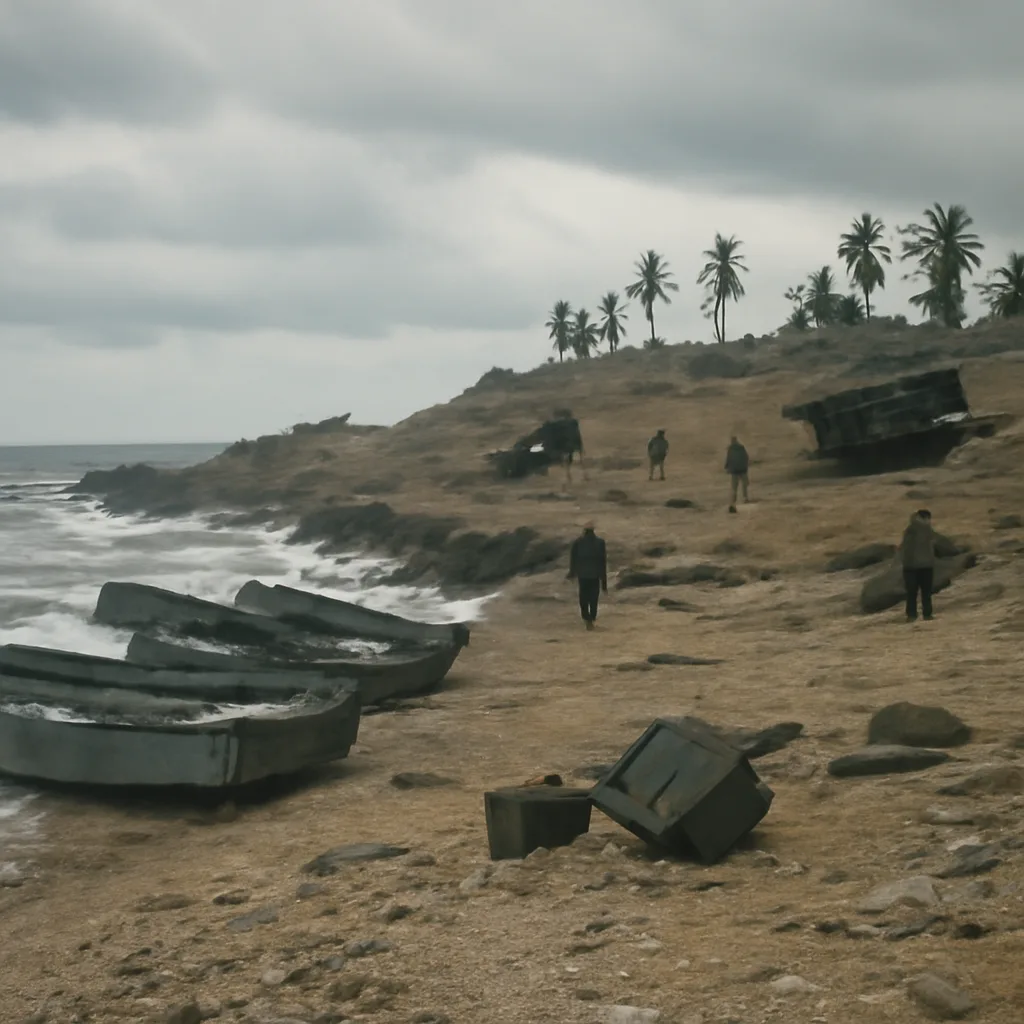
In April 1961 a force of roughly 1,400 Cuban exiles, trained and supported by the United States Central Intelligence Agency, attempted to invade Cuba at the Bay of Pigs (Playa Girón and Playa Larga) on the island’s southern coast. The operation—intended to trigger a popular uprising and overthrow Fidel Castro’s government—collapsed within three days after landings began on April 17. The invaders met unexpectedly strong resistance from Cuban armed forces, encountered logistical and air-support failures, and did not receive the broader popular support the planners anticipated. Background: After the 1959 revolution that brought Fidel Castro to power, relations between Cuba and the U.S. deteriorated amid nationalizations of U.S.-owned property and Castro’s alignment with leftist policies. The Eisenhower administration authorized covert plans to remove Castro; the Kennedy administration inherited and approved a modified version of that plan shortly after John F. Kennedy’s inauguration in January 1961. Plan and execution: The operation relied on a brigade of Cuban exiles (often called Brigade 2506) trained in Central America and on U.S. air strikes intended to neutralize Cuba’s air force and infrastructure. On April 15–16, US-sponsored air attacks damaged some Cuban planes, but did not eliminate air opposition. On April 17, exile forces landed at two beaches. From the start, Cuban government forces organized defense quickly, using tanks, artillery, and ground troops. The invading force was pinned on the beaches, supplies and reinforcements were limited, and promised broader popular insurrection and additional U.S. military intervention did not materialize. Outcome: Over the next 48–72 hours, Cuban forces overwhelmed the beachheads. Many of the invaders were killed or captured; approximately 1,100 were taken prisoner. The U.S. denied overt military involvement at first but later acknowledged the CIA role. The captured exiles were eventually released in December 1962 in a negotiated prisoner exchange for humanitarian supplies and cash payments. Consequences: The failed invasion was a major political setback for the Kennedy administration, which faced intense domestic and international criticism. It strengthened Castro’s position in Cuba and his ties with the Soviet Union, accelerating Cold War tensions in the Western Hemisphere. The episode also prompted U.S. policymakers to reassess covert action and crisis planning; it influenced subsequent U.S. approaches to Cuba, including economic embargoes and later clandestine efforts to destabilize Castro’s government. Historical interpretation: Scholars generally agree the operation failed due to a combination of poor planning, intelligence and coordination problems, underestimation of Cuban defenses, and misjudged assumptions about popular reaction inside Cuba. Debates continue about the extent and character of U.S. responsibility, the decision-making processes within the Kennedy administration, and the operation’s longer-term strategic effects in the Cold War. Sources and reliability: This summary synthesizes well-documented historical accounts based on declassified U.S. government records, contemporaneous reporting, and later scholarly studies. Specific casualty and prisoner figures vary slightly among sources; where precise numbers differ in the historical record, the summary uses commonly cited approximations.