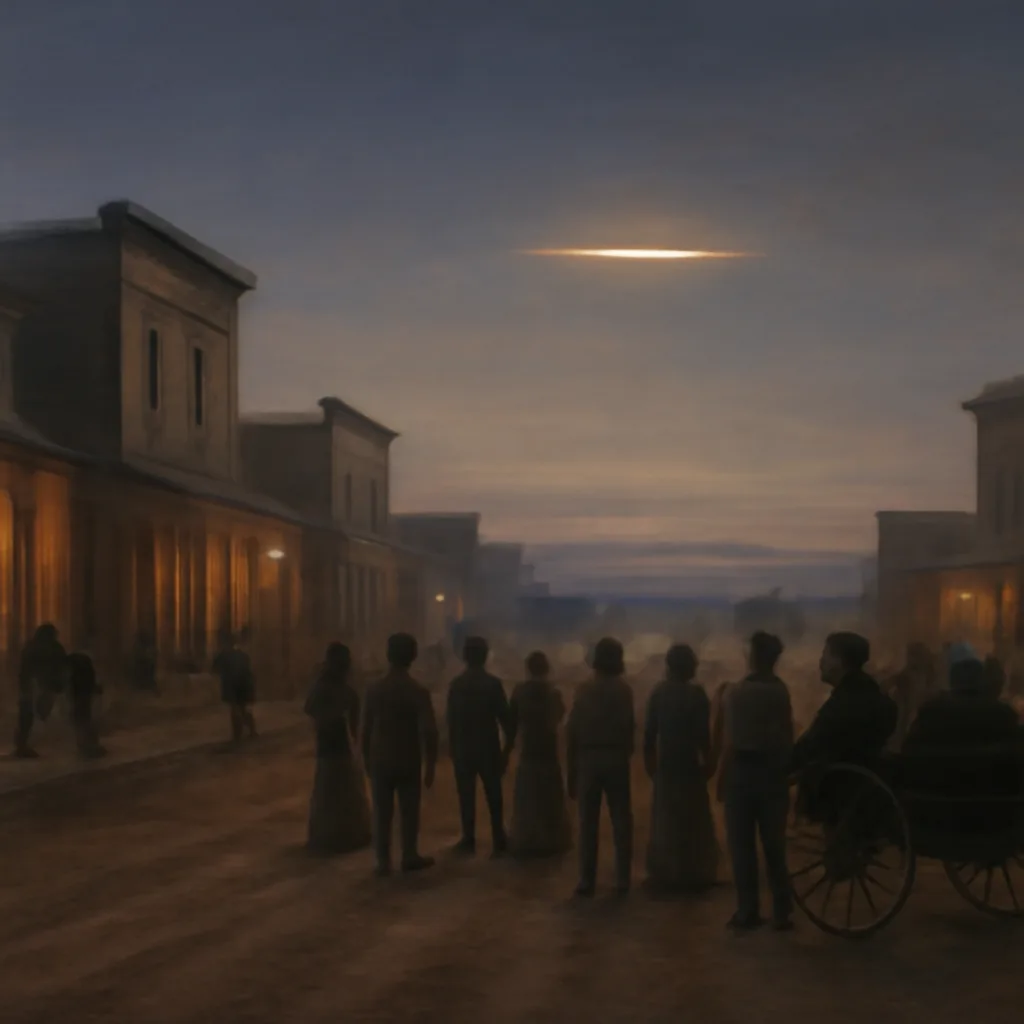
On January 24 in the late 1870s, newspapers in Kansas carried accounts of an unusual aerial sighting that later historians and UFO researchers would cite as one of the earliest American reports resembling modern UFO descriptions. Contemporary reports described a bright, elongated or cigar-shaped object moving through the evening sky, sometimes compared to a comet or balloon but distinguished by steady, controlled motion and an apparent metallic or luminous appearance. The incident occurred in a period of rapid technological change—balloons, new telegraph networks, and increasing public fascination with atmospheric phenomena—so readers then and now considered several possible explanations. Primary evidence for the event derives from local newspaper accounts and later retellings. Reports are terse and vary in detail: some witnesses reported a long, cylindrical form with bright light; others emphasized a slow, deliberate transit across the horizon. The accounts did not include the extensive instrumentation or photography available in later decades, and no preserved contemporary photographs or scientific instrument readings are known. As a result, modern reconstructions must rely on fragmentary press descriptions and subsequent summaries by historians and investigators. Interpretations of the sighting have ranged from mundane to speculative. Possible natural explanations include an uncommon perspective on a comet, an atmospheric optical effect, or an observation of a tethered or free balloon reflecting sunlight at twilight. Technological alternatives include an early experiment with dirigibles or other lighter-than-air craft, although documented trials of such craft in Kansas at that exact time are lacking. Skeptical historians stress that nineteenth-century newspaper accounts frequently used dramatic language and that errors in distance, size, and speed are common in eyewitness testimony, especially for unfamiliar aerial phenomena. Why the 1878 Kansas report attracts attention is partly retrospective: twentieth-century UFO researchers searching for antecedents to mid-twentieth-century encounters cataloged earlier anomalous-sky reports and highlighted cases that resembled later descriptions—elongated, metallic-seeming objects, silent motion, or brightness not matching known celestial bodies. This historical framing can create the impression of continuity between disparate reports that were described using different cultural vocabularies and scientific understandings. Careful historical treatment requires noting uncertainties and limits. The exact year of the Kansas sighting is sometimes given as 1878 in secondary sources; contemporaneous newspaper datelines point to a late-January report but do not preserve exhaustive detail about location, number of observers, or follow-up investigation. No surviving official inquiry or instrument-based verification is recorded. That leaves room for multiple plausible readings but prevents definitive identification. In sum, the January sighting in Kansas stands as an instructive example of how nineteenth-century atmospheric and aerial reports can be read in multiple ways: as possible observations of unexplained phenomena, as misidentified natural or technological occurrences, or as artifacts of reportage and interpretation. It is valuable to historians and researchers not as proof of a single theory but as a demonstration of how the historical record shapes, and sometimes limits, our ability to reconstruct past anomalies.