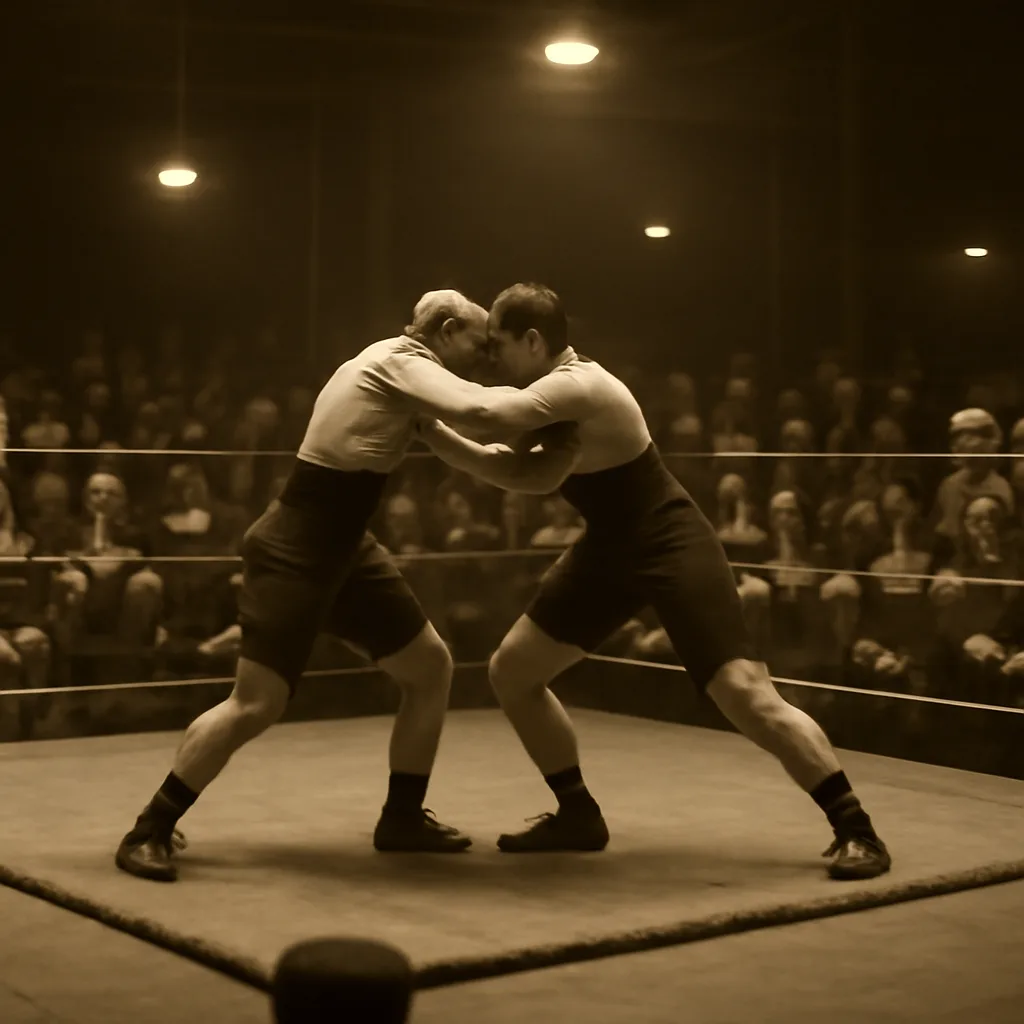
The First Recognized Professional Wrestling Championship Match, April 10, 1905
On April 10, 1905, in New York City, Frank Gotch defeated Tom Jenkins in a match often cited as one of the earliest recognized professional wrestling championship bouts—part of a transitional era when catch-as-catch-can wrestling moved from challenge contests toward promoted title matches.
The match on April 10, 1905, staged in New York City between Frank Gotch and Tom Jenkins is frequently cited by historians as among the earliest recognized professional wrestling championship contests in the United States. This bout took place during a period when wrestling was shifting from a mixture of legitimate challenge matches, exhibition grappling and carnival-style contests toward more organized, promoted championship bouts that drew paying crowds and media attention.
Frank Gotch, a wrestler from Iowa, and Tom Jenkins, representing the turn-of-the-century American wrestling tradition, were both practitioners of catch-as-catch-can, a style that permitted a wide range of holds and submissions and that had become popular in the United States after being imported from British and Lancashire wrestling traditions. By the early 1900s, catch wrestling had developed a roster of prominent competitors and increasingly formalized contests claiming championship status.
Primary contemporary newspaper reports and later wrestling historians note that the Gotch–Jenkins encounters (they met multiple times) were presented publicly as championship-level contests. The April 10, 1905 meeting is often singled out because it occurred as part of a series of high-profile matches that elevated Gotch’s standing among American fans and helped crystalize the notion of a recognized professional champion in U.S. wrestling. Over the ensuing years Gotch’s victories—and his later, better-documented wins over European champion Georg Hackenschmidt—cemented his reputation as a preeminent champion of the era.
It is important to acknowledge that the concept of a single, universally accepted professional wrestling championship did not exist in the same way it does in modern sports. Turn-of-the-century wrestling featured regional claimants, challenge matches, and promoters who sometimes presented contests as championship bouts for promotional purposes. Sources differ on which match should be called the “first” professional wrestling championship because earlier matches were promoted locally as championships and records from the period are incomplete. As a result, historians usually characterize the April 10, 1905 Gotch–Jenkins match not as an incontrovertible global first but as an early, well-documented example of a promoted professional championship contest that contributed to the sport’s emerging championship culture.
The bout’s significance lies both in its participants and in its timing. Gotch’s rise paralleled a growing public appetite for organized, marquee contests. Promoters increasingly billed matches as championship showdowns to attract paying audiences and press coverage. The public reception of matches like Gotch versus Jenkins helped establish the commercial model—ticketed events, newspapers reporting results, and the use of “champion” billing—that would come to define professional wrestling promotion in the 20th century.
Modern accounts that discuss the origins of professional wrestling championships typically place the Gotch–Jenkins matches among several formative moments rather than declaring a single definitive starting point. For readers seeking primary evidence, contemporary newspaper coverage from the first decade of the 1900s, period sporting journals, and later archival compilations by wrestling historians offer the best available documentation, while acknowledging gaps and regional variation in records.
In short, the April 10, 1905 match between Frank Gotch and Tom Jenkins stands as an early, influential example of a promoted professional wrestling championship contest in America—an event representative of a transitional era when organized title matches began to replace varied local challenge contests and exhibition bouts.