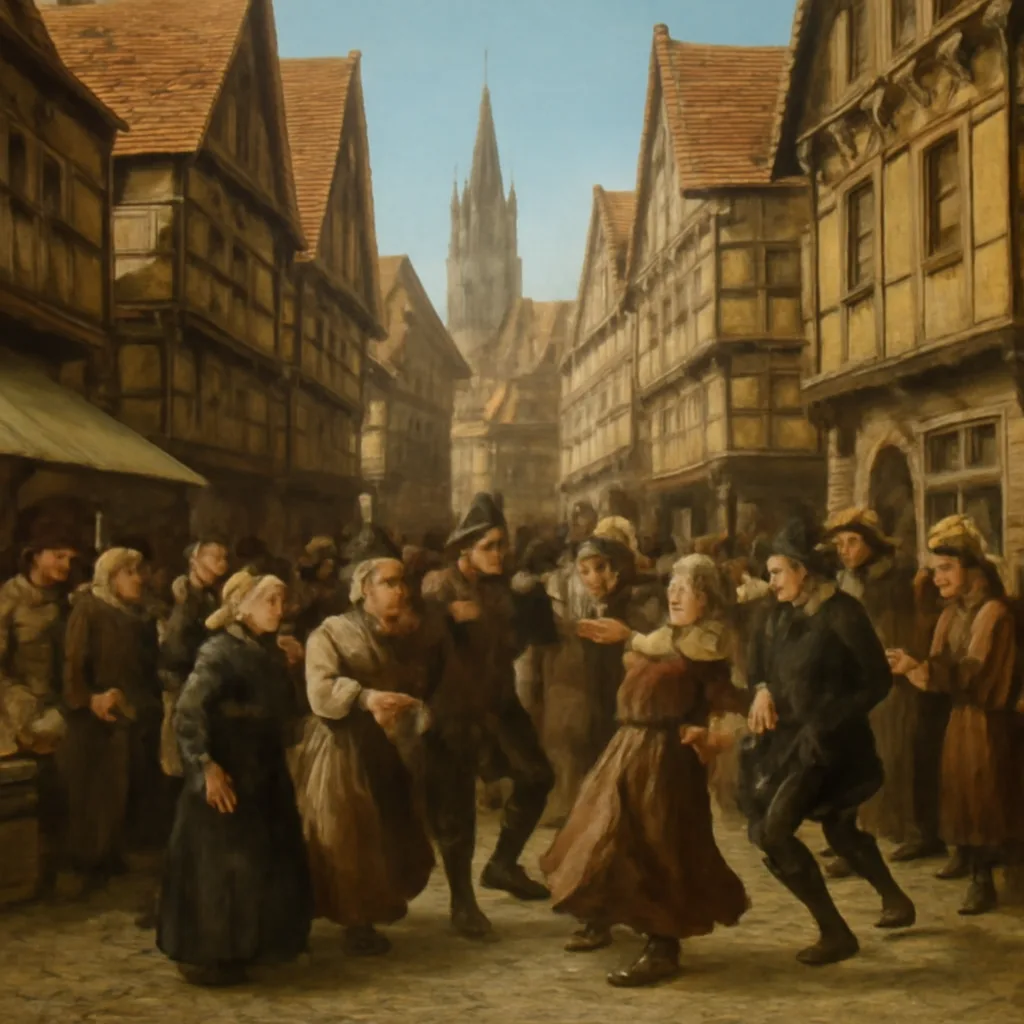
The 1518 Strasbourg Dancing Plague: the first well-documented outbreak of contagious dancing
In July 1518, residents of Strasbourg (then in the Holy Roman Empire) witnessed a sudden outbreak of involuntary, prolonged dancing that spread through the city for weeks. Contemporary accounts describe dozens of people dancing until exhaustion, and historians continue to debate its causes.
In July 1518 a woman in Strasbourg, then part of the Holy Roman Empire, stepped into a public street and began to dance uncontrollably. Within days others joined her, and the phenomenon grew into a sizable outbreak: contemporary municipal records and narratives report dozens of people dancing for days or weeks, often collapsing from exhaustion. The incident has been called the “dancing plague” or “dance epidemic” and is the earliest outbreak of contagious dancing that is well documented in European sources.
Sources and documentation
Primary evidence for the event comes from city council records, physicians’ reports, and chronicles written shortly after 1518. These sources describe municipal efforts to manage the situation—attempts included isolating sufferers and, at one point, organizing supervised dancing in the hope that the compulsion would run its course. These responses reflect how local authorities interpreted and tried to contain a disorder they perceived as both a public-health problem and a social disturbance.
What happened
Accounts vary in detail and emphasis. Most agree that the outbreak began with a single woman and spread to dozens of people, primarily women, who danced in public spaces. Reports mention rhythmic, involuntary movements that persisted for hours or days, with some sufferers reportedly collapsing, suffering strokes, or dying—details that historians treat cautiously because of the fragmentary and sometimes inconsistent nature of the records. The episode lasted several weeks before subsiding.
Interpretations and debates
Historians and medical researchers have proposed multiple, often competing explanations:
- Mass psychogenic illness (mass hysteria): Many scholars view the outbreak as an example of collective stress-induced behavior. Strasbourg in 1518 faced famine, disease, and social strain; psychological distress can manifest in somatic and behavioral symptoms that spread through social contagion.
- Neurological or toxic causes: Some researchers have suggested ergotism (poisoning from Claviceps-infected rye) or other toxins as possible triggers. However, ergotism typically produces hallucinations, convulsions, and gangrene in patterns that do not match all aspects of the Strasbourg reports, and there is limited direct evidence for an ergot outbreak at that time and place.
- Religious or ritual interpretation: Contemporary observers sometimes framed the dancing in moral or supernatural terms—possession, divine punishment, or saintly affliction—reflecting the period's worldview. Modern historians treat such explanations as valuable for understanding contemporary responses rather than as literal causes.
Why it matters
The 1518 outbreak matters for multiple reasons: it provides a detailed early example of a mass behavioral episode in European history; it illuminates how early modern authorities handled public-health crises; and it remains a case study in interdisciplinary debate among historians, psychiatrists, epidemiologists, and toxicologists. The limits and biases of surviving sources mean that no single explanation has achieved consensus.
Remaining uncertainties
Key facts about the episode remain disputed or uncertain: the exact number of sufferers, the proportion who suffered lasting harm or death, and whether a single biological agent played a decisive role. Because the evidence derives from administrative and narrative records with their own agendas and limitations, modern reconstructions emphasize competing hypotheses rather than definitive conclusions.
Legacy
The 1518 Strasbourg dancing plague has entered scholarly literature and popular imagination as a striking early-modern incident. It is used in research and teaching to discuss mass psychogenic illness, the social history of medicine, and how communities interpret and respond to sudden, poorly understood afflictions. The episode is notable less as a solved medical case than as a window into how people in 1518 perceived bodies, minds, and social contagion.