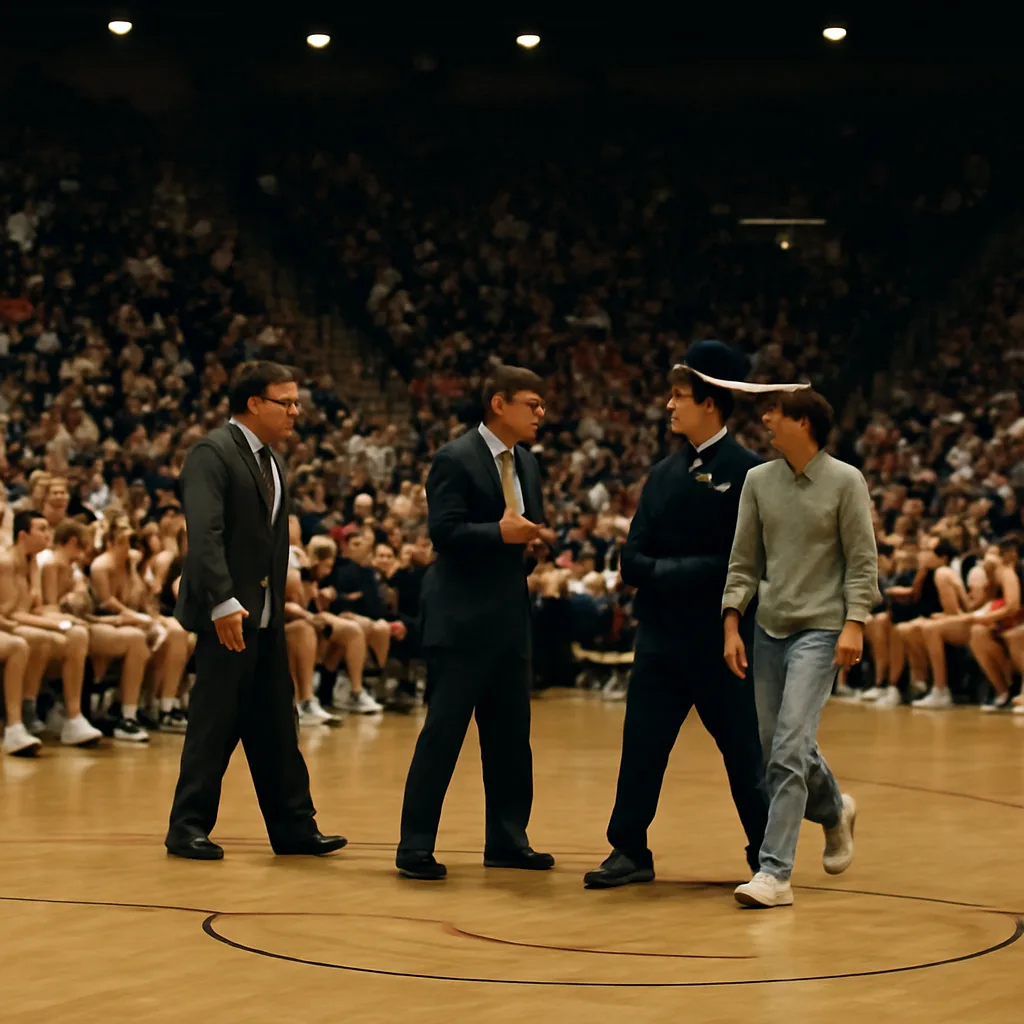
On November 14 (year commonly reported as 1998 in contemporaneous accounts), a college basketball game was interrupted when a player was handcuffed and removed from the court by law enforcement during a timeout. The incident occurred in the midst of live play stoppage, drawing players, coaches and fans to the sidelines as officials conferred and police positioned themselves to take the individual into custody. Accounts from the period describe a tense, disorienting scene: a timeout had been granted, teams were gathered near their benches, and spectators were awaiting the resumption of play when officers entered the playing area. The detained player was escorted away, and after a short delay officials resumed the game. Local media covered the episode, noting both the unusual nature of an on-court arrest during an organized sporting event and the procedural questions it raised about venue security, player privacy and coordination between athletic departments and police. Contemporaneous reports differ on some specifics—such as whether the arrest stemmed from an outstanding warrant, an alleged incident unrelated to the game, or immediate concerns raised at the venue—so definitive, single-source conclusions are not available. University statements at the time generally emphasized cooperation with law enforcement while seeking to minimize disruption to the competition. Law enforcement sources cited public-safety obligations, and athletics officials later reviewed protocols for handling legal actions involving athletes during events. The event highlighted several recurring issues for collegiate athletics in the 1990s: the balance between maintaining game integrity and responding to law-enforcement obligations, the optics of police action in front of fans and media, and the need for clear preexisting plans for on-site arrests or detentions. Policies that many athletic programs have since formalized include advance notification procedures, designated holding areas away from public view, and liaison roles between campus police and athletic departments to avoid in-game confrontations or distractions. Because contemporary reporting varies and institutional records are not uniform, some details remain ambiguous in the public record. Sources from the time include local newspaper coverage and university press releases; later retrospectives on unusual sports incidents sometimes cite the episode as an example of midgame law-enforcement action but do not always provide new documentation. For researchers or readers seeking primary-source verification, consulting archived local news reports from November 1998 and official statements from the institutions involved is the recommended next step. The episode endures in discussions about sports-event management as a reminder that public-safety responsibilities occasionally intersect with live competition, and that transparent protocols help protect the rights and safety of individuals while preserving the integrity of athletic contests.