
Early Public Demonstration of Weather Modification Held in June 1947
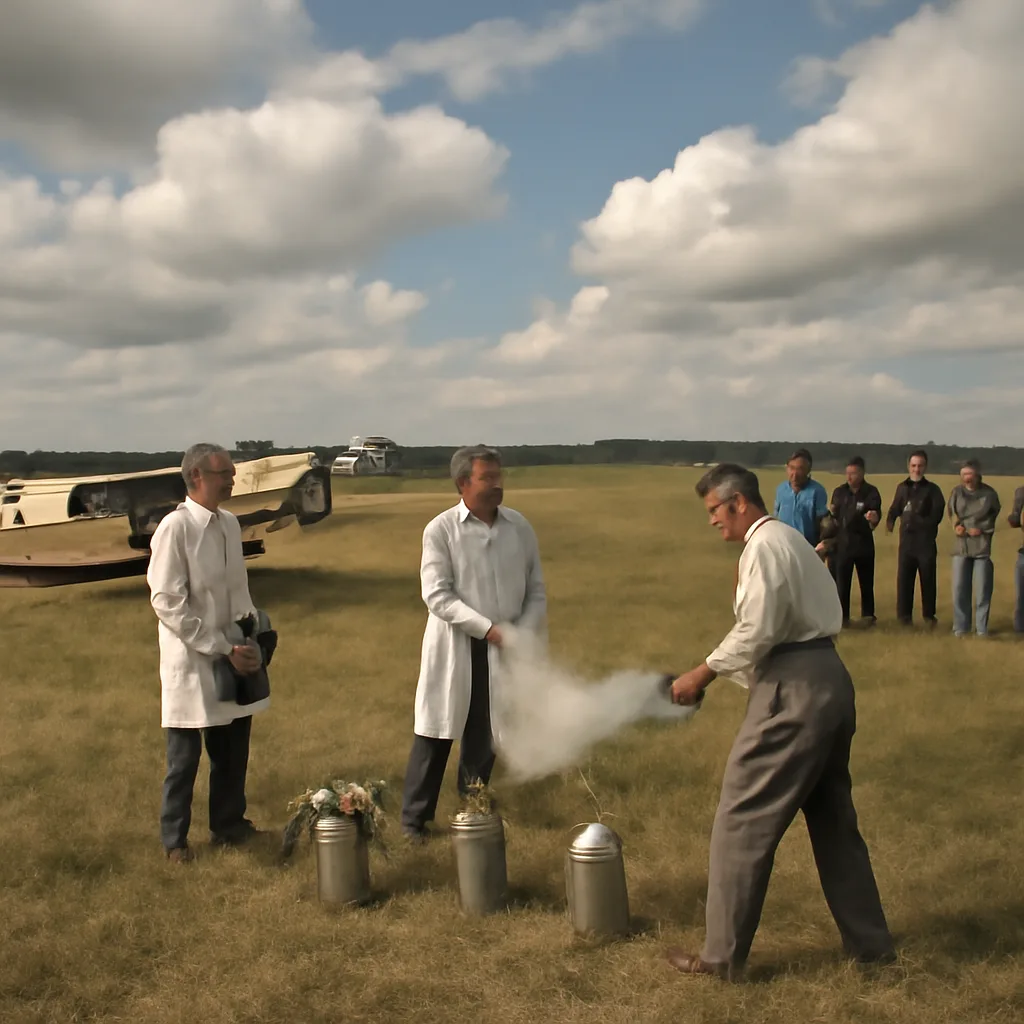
On June 17 (year disputed in sources), a public demonstration of weather modification techniques — notably cloud seeding experiments developed in the 1940s — was staged, reflecting growing postwar interest in influencing precipitation though methods and outcomes remained experimental.
In the 1940s, researchers began experimenting with deliberate attempts to influence precipitation. The most widely reported early method was cloud seeding, pioneered by scientists such as Vincent J. Schaefer and Bernard Vonnegut, who in 1946–1947 demonstrated that dispersing substances like dry ice or silver iodide into clouds could induce ice crystal formation and, under some conditions, produce precipitation.
Public demonstrations of these methods followed quickly after laboratory and field work. One such demonstration occurred on June 17 in 1947 (the exact year attached to some public accounts is disputed or variably reported in secondary sources). Organized displays typically sought to show municipal and scientific audiences that cloud seeding could be used to increase rainfall or clear fog, and they reflected wider postwar optimism about applied atmospheric science.
These demonstrations were experimental and limited in scope. Field conditions, the type of clouds present, and methods of dispersal all affected outcomes, and early proponents acknowledged uncertainty about how reliably seeding produced rainfall. The early experiments and demonstrations did, however, spur further research and governmental interest. Through the late 1940s and into the 1950s, universities, private companies, and government agencies expanded cloud-seeding trials, sometimes for agricultural purposes or to reduce fog at airports.
Historical accounts emphasize both the scientific novelty and the publicity aspects of early demonstrations. Newspapers and scientific bulletins covered events to communicate potential benefits, but also noted the experimental nature of the work. Over subsequent decades, the efficacy, environmental effects, and ethics of weather modification continued to be studied and debated, leading to more systematic trials and regulatory attention.
Because contemporary reporting and later summaries sometimes conflate dates and specific events, researchers citing any single public demonstration should cross-check primary sources — such as newspaper reports from the locality and date in question, institutional records from participating laboratories or agencies, and contemporaneous scientific publications — to verify exact details. What is clear in the historical record is that public demonstrations in the mid-to-late 1940s played a notable role in popularizing cloud seeding and stimulating further research into deliberate weather modification.