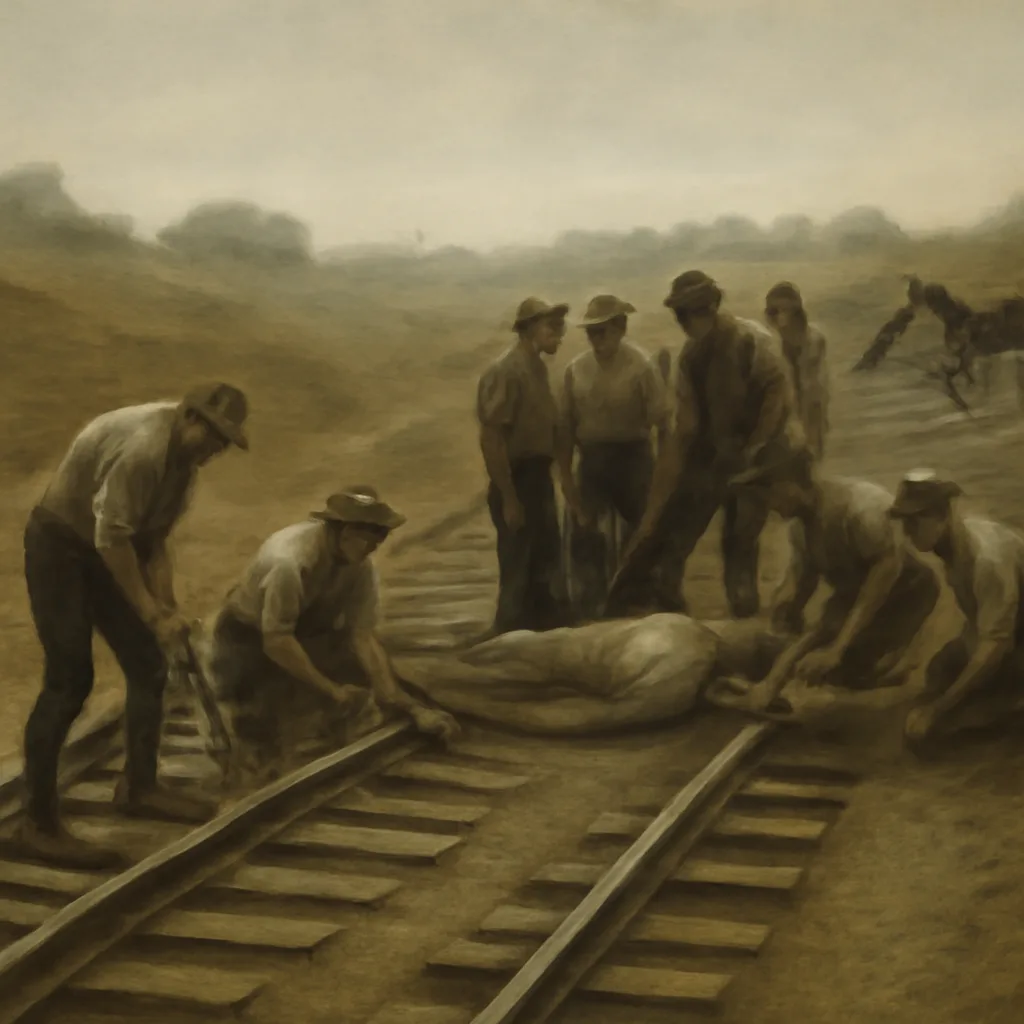
On or around July 13, 1848, several American newspapers and later retellings recorded a gruesome construction accident in which a laborer was struck by a railroad spike that penetrated his skull. Coverage of the incident in mid-19th-century press is inconsistent: some accounts give the date as July 13, others list nearby days in July; names and precise locations are rarely agreed upon. What is consistent across primary reports is that the injury occurred during rail construction or maintenance, involved a long iron spike or bolt, and left the man immobilized until he could be tended to. Mid-19th-century railroad work was dangerous. Crews used hand tools, heavy iron spikes, and primitive equipment; accidents from falls, crushed limbs, or puncture injuries were commonplace. Medical knowledge and battlefield-influenced surgery of the era could sometimes handle penetrating cranial wounds, particularly when the projectile was clean and the patient reached care promptly. Surviving long enough to receive treatment was therefore possible, and individual cases of remarkable survival were often reported in local and national papers, sometimes with sensationalism. Contemporary newspaper descriptions of the July 1848 incident emphasize the shock of witnesses and the visible presence of the spike protruding from the skull. Reporters noted that the injured man was conscious or semi-conscious at varying times, that he complained of severe pain or stupor, and that colleagues hurried him to medical attention. Some reports claim the man survived the initial trauma and transport; others suggest he later succumbed to his wounds. No single authoritative medical record or verified coroner’s report has been located that conclusively establishes the victim’s identity, long-term outcome, or precise medical treatment received. Medical practice in 1848 could include cautious attempts at extraction, cleaning the wound, and controlling hemorrhage and infection, though antiseptic techniques were not yet in general use. Surgeons faced high risks of infection, and outcomes depended on wound contamination, depth and path of penetration, and the patient’s condition. In cases where metal objects passed through nonvital brain tissue or skirted major vessels, survival—at least in the short term—was recorded occasionally. These rare survivals attracted wide attention in newspapers and later human-interest retellings. Historians treating such reports urge caution. Newspaper accounts from the period are valuable but can be inconsistent, embellished, or truncated as they were reprinted across papers. The absence of a consistent name, medical log, or institutional record for this specific July 1848 accident makes definitive statements about the man’s fate or the precise mechanics of the injury impossible. What can be stated with reasonable confidence is that an incident involving a spike driven into a man’s skull was reported in July 1848, that contemporaries treated it as remarkable, and that the episode illustrates both the hazards of early railroad construction and the limits of mid-19th-century medical care. Without additional primary documentation—such as a hospital ledger, surgeon’s note, or coroner’s certificate—many details will remain uncertain. Researchers interested in verifying particulars should consult digitized newspapers from July 1848, regional archives of railroad companies active at that time, and medical journals or casebooks from area hospitals. Such sources may clarify location, identity, and outcome, or confirm that the story circulated primarily as a widely reprinted anecdote of industrial peril.